The parts that matter, named properly.
WireGuard and OpenVPN
WireGuard for speed, OpenVPN for networks that filter it. The app switches on its own when a handshake fails, and you can pin either one by hand.
ChaCha20-Poly1305 on WireGuard, AES-256-GCM on OpenVPN. Both are public, audited protocols we did not write ourselves — that is the point.
WireGuardOpenVPN UDPOpenVPN TCPRAM-only servers
Nothing is written to a disk, because there is no disk. Every server loads its OS into memory and forgets everything the moment it is power-cycled.
The whole fleet reboots on a schedule. A seized machine is a blank machine — not a promise about what we chose to delete.
No activity logs
We do not record what you visit, what you resolve, or when you connect. What we keep is your email and your billing state, because a subscription needs both.
Stated plainly rather than as "military-grade". See the transparency panel below for what is verified and what is still pending.
Split tunnelling
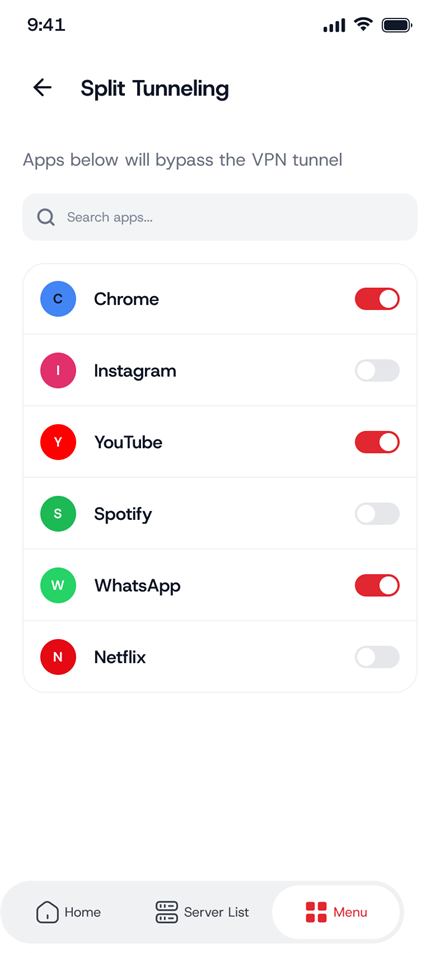
Send your bank through your own connection and everything else through the tunnel — or the reverse. Per-app on mobile, per-app and per-route on desktop.
Rules survive a reconnect, so you set them once. The tunnel comes back up with the same list it went down with.
Streaming that actually loads
A subset of servers is kept for streaming and checked daily. When one stops working we take it out of the list instead of leaving you to find out.
No provider can promise a specific service forever, and any that does is guessing. We publish which regions are working this week.
Public Wi-Fi cover
The kill switch drops your traffic if the tunnel does, so a hotel network never sees a gap. It is on by default rather than buried in settings.
DNS resolves inside the tunnel as well, so the lookups do not leak around it while the traffic is covered.
Networks that filter VPNs
Campus Wi-Fi, hotel portals, and countries that block VPN traffic outright. OpenVPN over TCP 443 looks like ordinary HTTPS, and the app falls back to it on its own.
We will not claim this works everywhere — filtering changes, and a provider promising a permanent answer is guessing. It works on most networks that block WireGuard, and the refund window covers you if yours is not one of them.
Take the privacy back. On your terms.
700+ servers in 90+ countries, a no-logs policy we state plainly, and an audit we will tell you about the day it happens.
- Free tier, no card
- 5 devices per plan
- 30-day refund